


Data Centers
Data centers have become one of the most talked-about topics in the electric industry. We know members have questions about what they are and what they could mean for electric systems. As a member-owned cooperative, transparency and education matter.
Central Rural Electric Cooperative understands our members’ uncertainty regarding data centers and their potential impacts on the electric grid and rates. We want our members to know that our priorities will always be providing our members with safe, affordable and reliable electricity. These are the three things we keep in mind when evaluating any new load requests.
Central has an obligation to serve all members that request electric service within our service area and that agree to operate in accordance with our terms and conditions, bylaws and other governing documents. Our goal is to provide safe and reliable electricity to all members at an affordable cost, and our rate structures are designed to provide equity among all members. If a new load request will negatively impact our membership, Central will not agree to provide electricity.
Central is currently not serving any data centers, however, we have had discussions with a few data center companies. While the scale and speed of data center power needs is unprecedented, serving large loads is not new to Central. For years, Central has worked with large energy-users such as oil and gas producers while protecting all rate classes of members. Our approach remains the same - ensuring costs are equitably distributed among the members.
The energy industry is constantly changing. Central works to stay at the forefront of these changes to protect our members. You can rest assured that maintaining fair, affordable, reliable and safe electricity for you will always be our number one priority.
Do you have more questions related to data centers? Read through our frequently asked questions below to see what other members are asking.
Data Center FAQs
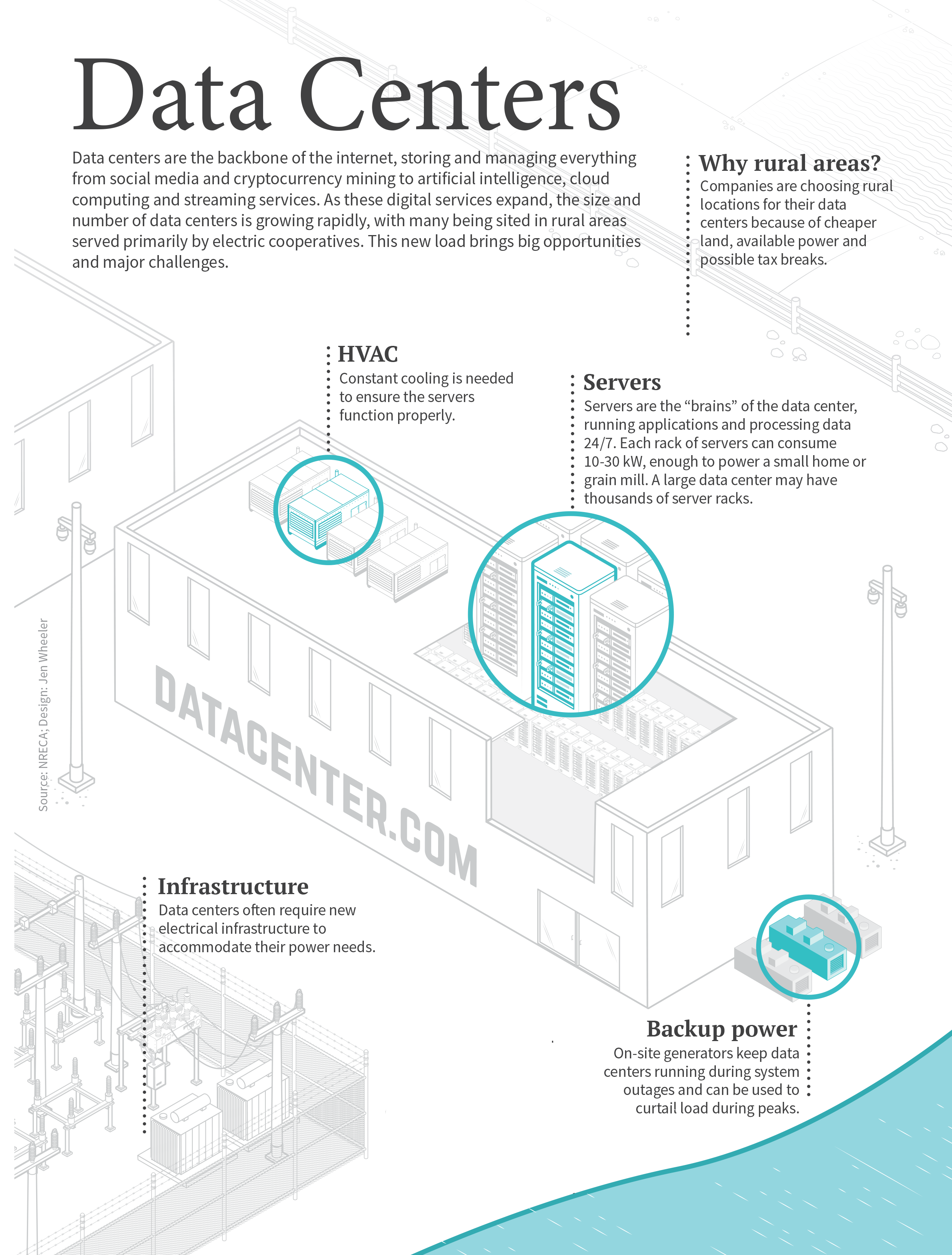
Data centers are facilities that house networks of servers providing data storage and processing capabilities, supporting a digitally connected world. Data centers power digital tasks such as Google searches, Amazon purchases or Chat GPT requests.
Central has an obligation to serve any potential member who requests service and follows the established terms and conditions of service in place to ensure the membership is protected from adversity. When a potential member requests power from Central, the request is reviewed by our team and, if feasible, a cost estimate and scope of work are determined.
Central has been contacted by a few data centers, and we have had discussions with them. These discussions are important as they help us determine, in coordination with our power provider, if capacity is available and/or if there will be any system improvements required.
At this time, Central is not serving any data centers, nor is Central actively pursuing data centers.
No, it is a coordinated effort among Central; KAMO Power, our power provider; and Associated Electric Cooperative Inc. (AECI).
Central is part of a three-tiered cooperative system. AECI is the generation cooperative. All the power that Central provides its members comes from AECI. KAMO Power is the transmission cooperative and is responsible for moving large amounts of electricity across the region. KAMO Power owns and operates all of Central’s substations and the transmission lines that connect them.
Serving new large loads requires coordination and agreement across all three tiers to ensure capacity and reliability for all members.
Data centers require large amounts of power to operate servers and cooling systems. Some hyperscale data centers, as the largest are known, draw as much as a gigawatt of electricity.
Power reliability and availability are something at the forefront of Central’s goals and objectives. Each year, we complete extensive load forecasting to determine our capacity needs to meet our current and projected demands. This load forecasting also helps KAMO Power and AECI determine how much power they will need. We cannot connect a load if there is not sufficient capacity from KAMO and AECI to meet our current and projected demands.
Simply put, a load will not be connected if capacity is not available.
Central requires all members to pay contribution in aid for any costs above and beyond Central’s standard line extension as outlined in its terms and conditions. Data centers are no exception and will be required to pay upfront for infrastructure and equipment directly associated with serving data centers. In addition, they would be required to pay 100 percent of the costs associated with substation and transmission improvements needed.
Yes. Data centers use electricity steadily throughout the day and night. That steady usage helps balance the electric system and can lower overall costs, helping keep rates more stable and reducing changes in the power cost adjustment (PCA) on members’ bills.
There are certainly environmental impacts from data centers, and these must be carefully mitigated. Central is not the subject matter expert on environmental topics such as noise, water quality, etc. Luckily, there are other agencies with governing authority over data center impacts on the environment.